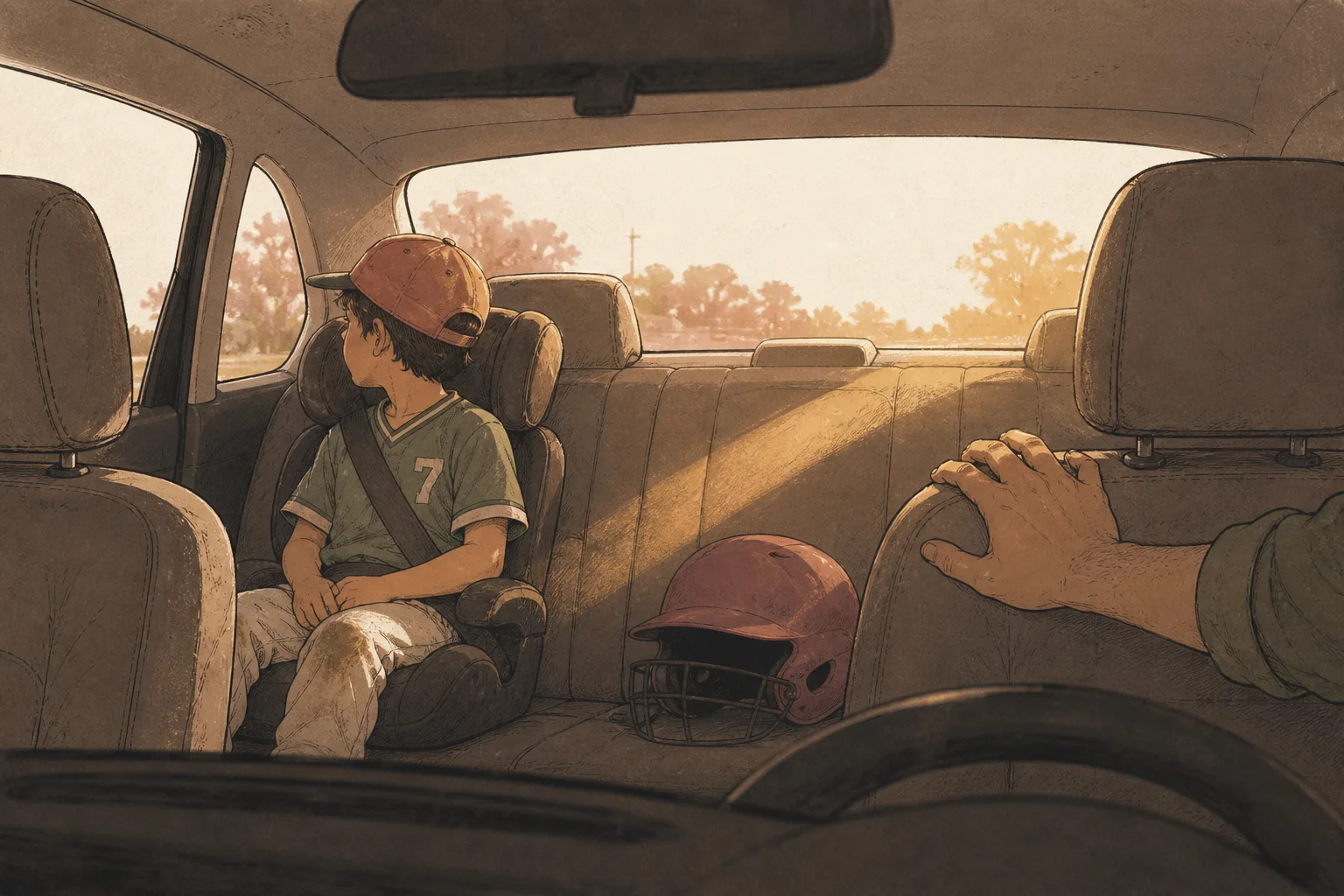
A six-year-old gets in the car after a Saturday tee-ball game. Tee-ball, where there are no strikeouts. Tee-ball, where the rules are written specifically to keep kids from feeling bad. The kid in the back seat is still upset. He missed two ground balls and forgot which way to run after he hit the ball.
The parent in the front seat tries the obvious. “You did great, buddy.” The kid says nothing. “Want some ice cream?” Still nothing.
That parent has the same problem the parent of a high-school varsity kid has. The problem is not the score. The problem is the ride.
The framework
Every game, at every age, has three drives. The drive there. The game itself. The drive home.
The drive there is roughly fifteen minutes of pre-game prep. Mindset. The job for today. The reduction of stakes. The handoff at the parking lot.
The game is two hours of coaching and watching. Lineups. Substitutions. The strange and specific job of correcting your own kid in front of eleven other kids who are watching to see how you handle it.
The drive home is forty-five minutes long if you count the dinner table that night. The first ninety seconds of those forty-five minutes are the most important sentences your kid will hear from you all week.
Three drives. One relationship.
Most parents obsess over the middle
The middle is the part everybody talks about. The film. The play call. The pre-game speech. The coaching clinics, the certifications, the Twitter threads. All middle.
The middle is also the smallest part of the relationship.
Two hours on the field. Twenty-two hours in the car, the kitchen, the back yard, the bathroom doorway at eleven at night when your kid finally tells you what they were upset about. The middle is one ninth of the day. The bookends are everything else.
The bookends are where development happens. Not skill development. The other kind. The kind that decides whether your kid still wants to be doing this in three years.
What the bookends actually do
The drive there sets the temperature for the day. Spend it drilling the lineup, the kid hears pressure. Spend it grounding them and handing them one specific job, they walk into the dugout calm and brave.
The drive home decides what the next week looks like at home. The first ninety seconds are a window. The kid is asking, without using these words: is this still a place I want to be? The answer they get from your face and your first sentence sets the rest of the week.
This is the part nobody warns you about. There is no certification for the drive home.
Why tee-ball matters here
Tee-ball is the proof. The rules of tee-ball were written to make sure six-year-olds want to come back next week. No strikeouts. No outs in some leagues. Everybody bats every inning. The score is barely tracked. The whole game is engineered around the question: did the kid have fun and want to come back.
That question doesn’t go away when the kid turns eight. Or eleven. Or fourteen. The question gets harder to ask out loud because the games start to feel important. But the question is still the only one that matters.
The drive home is where that question gets answered. Not in the box score. Not in the lineup card. In the first thing you say when the kid puts the seatbelt on.
Coach the team. Keep the kid.
The hardest job in youth sports is treating your kid like every other kid for two hours, then putting them back in the car as your kid.
Most parent-coaches handle the transition wrong. They overcorrect to look fair, which the kid hears as you’re mad at me. Or they overcompensate to protect, which the team hears as the coach has a favorite. Either way, the kid notices. All the other kids notice.
The rule that works, after watching coaches get it wrong and start to get it right: coach the team in the dugout. Keep the kid in the car. Both jobs are full-time. Neither one is more important than the other.
If you cannot do both, get a different parent to coach the team. There are seasons when that is the right call. We are saying that out loud because nobody else will.
What this site is for
This site is not a coaching certification. It is not a parenting framework with capital letters. It is sideline notes from parents who have done this for years across different teams, different kids, different sports.
If you’re the parent who is also the coach, the rest of those notes live at /parent-coach/.